
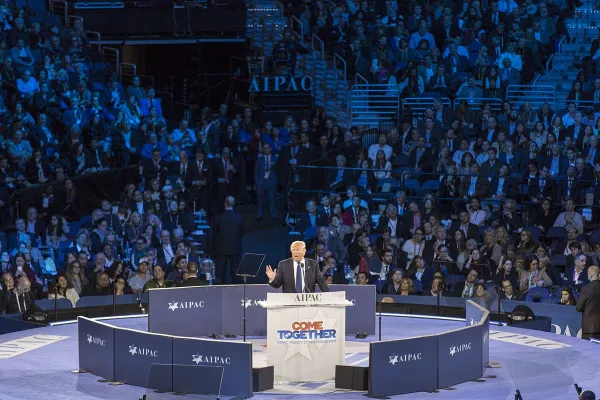
Trump speaking at AIPAC: Lorie Shaull, CC BY-SA 4.0 <https://creativecommons.org/licenses/by-sa/4.0>, via Wikimedia Commons
American democracy is often framed as a system designed to represent the will of the people. Built on the framework of the United States Constitution, it promises political equality, accountability, and broad participation. Central to this system is the right of citizens to influence government decisions—a principle protected by the First Amendment, which guarantees the right to petition the government.
Over time, however, this principle has evolved into the modern practice of lobbying. Originally intended as a mechanism through which diverse voices could be heard, lobbying today raises fundamental questions about whether American democracy still functions as intended. In theory, lobbying operates as a pluralistic system: businesses, labor unions, advocacy groups, and citizen movements compete to shape public policy. Political theorists such as Robert Dahl argued that such competition prevents any single faction from dominating the system. Ideally, this balance forces policymakers to consider a wide range of perspectives.
In practice, this balance has eroded. Lobbying in the United States has become a highly professionalized and capital-intensive industry, reshaping the distribution of political influence. The rise of Political Action Committees (PACs), Super PACs, and powerful advocacy organizations—such as the National Rifle Association (NRA), Americans for Prosperity, and the powerful American Israel Public Affairs Committee (AIPAC)—has dramatically increased the flow of money into elections and policymaking.
A pivotal moment in this transformation came with the Supreme Court’s decision in Citizens United v. FEC, which expanded political spending as a form of protected speech. This ruling enabled corporations, wealthy individuals, and organized lobbying networks to exert greater influence over elections and policy outcomes. At the same time, the “revolving door” between government and the private sector has allowed former public officials to transition into lobbying roles, shaping the very policies they once administered. Critics argue that these developments have pushed American democracy toward a plutocratic model—one in which policy outcomes increasingly reflect the priorities of wealthy actors rather than the broader electorate.
Nowhere is this dynamic more visible than in U.S. foreign policy, particularly in the Middle East. Here, policy is shaped by the interaction of two powerful and often overlapping spheres of influence: defense industry lobbying and pro-Israel advocacy organizations. Firms such as American Defense International, The Roosevelt Group, Cornerstone Government Affairs, and Brownstein Hyatt Farber Schreck represent major defense contractors including Lockheed Martin, RTX Corporation, and General Dynamics. These networks influence defense appropriations, arms sales, and legislation such as the National Defense Authorization Act (NDAA).
I describe the convergence of these forces as Plutozionism: the alignment of wealth-driven political influence with pro-Israel advocacy in shaping U.S. foreign policy. These are not identical systems, nor do they operate as a single unified bloc. However, their interests frequently converge—particularly around military aid, regional security priorities, and arms transfers—creating a reinforcing effect on policy outcomes.
The United States dominates the global arms trade, controlling over 40% of the market and exporting weapons to more than 100 countries. These exports are not merely commercial transactions; they function as instruments of foreign policy, used to strengthen alliances, project geopolitical influence, and advance strategic objectives. In practice, this has often meant supplying arms to authoritarian governments while sustaining the domestic defense industry.
Between 2020 and 2024, Saudi Arabia was the largest recipient of U.S. arms, accounting for roughly 12% of total exports. More broadly, the Middle East—particularly Saudi Arabia, Qatar, and the United Arab Emirates—remains a central market for U.S. weapons sales. This pattern highlights the extent to which strategic and economic priorities often outweigh concerns about human rights in American foreign policy.
This system is reinforced domestically by a deeply entrenched defense lobby. Major arms manufacturers spend millions annually influencing policymakers, directing an estimated $285 million in campaign contributions and $2.5 billion in lobbying expenditures over the past two decades. The revolving door between government and industry further amplifies this influence, allowing defense interests to shape policy from within.
Alongside these forces, pro-Israel lobbying organizations—most prominently AIPAC—play a significant role in reinforcing U.S.–Israel alignment. Through campaign contributions, direct lobbying, policy advocacy, and long-term relationship building with lawmakers, these organizations help sustain strong diplomatic, military, and strategic ties. While U.S. policy is also driven by broader geopolitical considerations, these lobbying efforts contribute to maintaining a consistent and durable alignment.
It is not coincidental that Israel remains one of the most strongly supported U.S. allies, receiving substantial financial aid, military assistance, and diplomatic backing. The United States has frequently used its influence in international institutions, including the United Nations, to shield Israel from censure. This support extends across multiple levels of government, where congressional resolutions and policy decisions consistently reinforce the alliance, even amid controversy over Palestinian territories and regional conflicts.
The current conflict with Iran further illustrates this alignment. The coordinated military campaign launched in late February 2026 by the United States and Israel against Iran reflects not only strategic considerations but also the influence of domestic political coalitions that favor a hardline approach. Critics argue that the core rationale behind this campaign—both in its initiation and execution—lacks clear international legal justification and has heightened regional instability while threatening broader global economic and security interests.
The influence of these lobbying networks is not confined to government and foreign policy. Recent protests related to the Gaza conflict on U.S. university campuses have revealed how political and financial pressure can extend into civil society. In several cases, major donors publicly pressured university administrations to take stronger action against student activism, sometimes threatening to withdraw funding. This dynamic illustrates a broader mechanism of influence: financial leverage.
Universities, like political institutions, depend heavily on external funding. When donors attach explicit or implicit conditions to their contributions, they can shape institutional responses to controversial issues. While such actions are legal and reflect the donors’ own rights, they raise serious questions about the limits of academic independence in donor-dependent institutions.
Conclusion:
What emerges is not a conspiracy or a hidden cabal, but something far more consequential: a system of converging power. Plutozionism names this reality—the alignment of corporate-driven political influence with entrenched pro-Israel advocacy in shaping U.S. foreign policy. It is a system in which money, access, and organized lobbying do not merely influence outcomes—they define the boundaries of what is politically possible, long before democratic debate even begins.
This convergence does not silence dissent outright. Elections are still held, debates still unfold, and opposition voices still speak. But these processes increasingly operate within invisible constraints. The result is a democracy that appears intact on the surface while being quietly narrowed beneath it—where certain policies, particularly in the Middle East, are effectively beyond challenge, no matter how public opinion shifts, how severe the humanitarian consequences become, or how clearly long-term American interests are put at risk.
The question Americans must confront is no longer abstract. It is immediate and unavoidable: do elections still function as instruments of accountability, or have they become carefully managed rituals that legitimize decisions made elsewhere? When elected officials—across party lines—remain insulated from public pressure on some of the most consequential issues of war and peace, the promise of democratic control begins to erode. What is at stake is not just policy, but legitimacy itself.
To understand Plutozionism is to confront how power actually operates—through overlapping networks of wealth, access, and political organization that shape outcomes beyond the reach of ordinary citizens. It reveals a foreign policy apparatus increasingly insulated from accountability, sustained not by broad democratic consensus but by durable alignments between economic power and organized advocacy.
If American democracy is to mean more than procedure—if it is to reflect the will of the people rather than the priorities of the powerful—this convergence cannot remain unexamined. It must be challenged. Without meaningful limits on the influence of concentrated wealth and lobbying power, the gap between democratic ideals and political reality will continue to widen, until decisions of war, peace, and global alignment are no longer meaningfully democratic at all.